
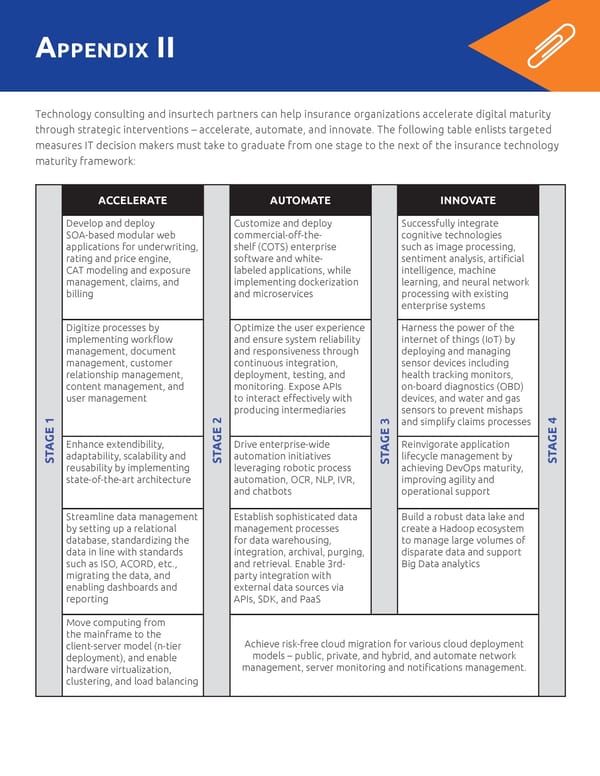
aPPendIx II Technology consulting and insurtech partners can help insurance organizations accelerate digital maturity through strategic interventions – accelerate, automate, and innovate. The following table enlists targeted measures IT decision makers must take to graduate from one stage to the next of the insurance technology maturity framework: ACCELERATE AUTOMATE INNOVATE Develop and deploy Customize and deploy Successfully integrate SOA-based modular web commercial-off-the- cognitive technologies applications for underwriting, shelf (COTS) enterprise such as image processing, rating and price engine, software and white- sentiment analysis, artificial CAT modeling and exposure labeled applications, while intelligence, machine management, claims, and implementing dockerization learning, and neural network billing and microservices processing with existing enterprise systems Digitize processes by Optimize the user experience Harness the power of the implementing workflow and ensure system reliability internet of things (IoT) by management, document and responsiveness through deploying and managing management, customer continuous integration, sensor devices including relationship management, deployment, testing, and health tracking monitors, content management, and monitoring. Expose APIs on-board diagnostics (OBD) user management to interact effectively with devices, and water and gas producing intermediaries sensors to prevent mishaps GE 1 GE 2 GE 3and simplify claims processes GE 4 A Enhance extendibility, A Drive enterprise-wide A Reinvigorate application A T T T T S adaptability, scalability and S automation initiatives S lifecycle management by S reusability by implementing leveraging robotic process achieving DevOps maturity, state-of-the-art architecture automation, OCR, NLP, IVR, improving agility and and chatbots operational support Streamline data management Establish sophisticated data Build a robust data lake and by setting up a relational management processes create a Hadoop ecosystem database, standardizing the for data warehousing, to manage large volumes of data in line with standards integration, archival, purging, disparate data and support such as ISO, ACORD, etc., and retrieval. Enable 3rd- Big Data analytics migrating the data, and party integration with enabling dashboards and external data sources via reporting APIs, SDK, and PaaS Move computing from the mainframe to the client-server model (n-tier Achieve risk-free cloud migration for various cloud deployment deployment), and enable models – public, private, and hybrid, and automate network hardware virtualization, management, server monitoring and notifications management. clustering, and load balancing
 The New Operating Model Page 12 Page 14